Focal mechanism
In seismology, a focal mechanism is a description of the possible geometries and slip direction of the fault that ruptured and caused the earthquake.
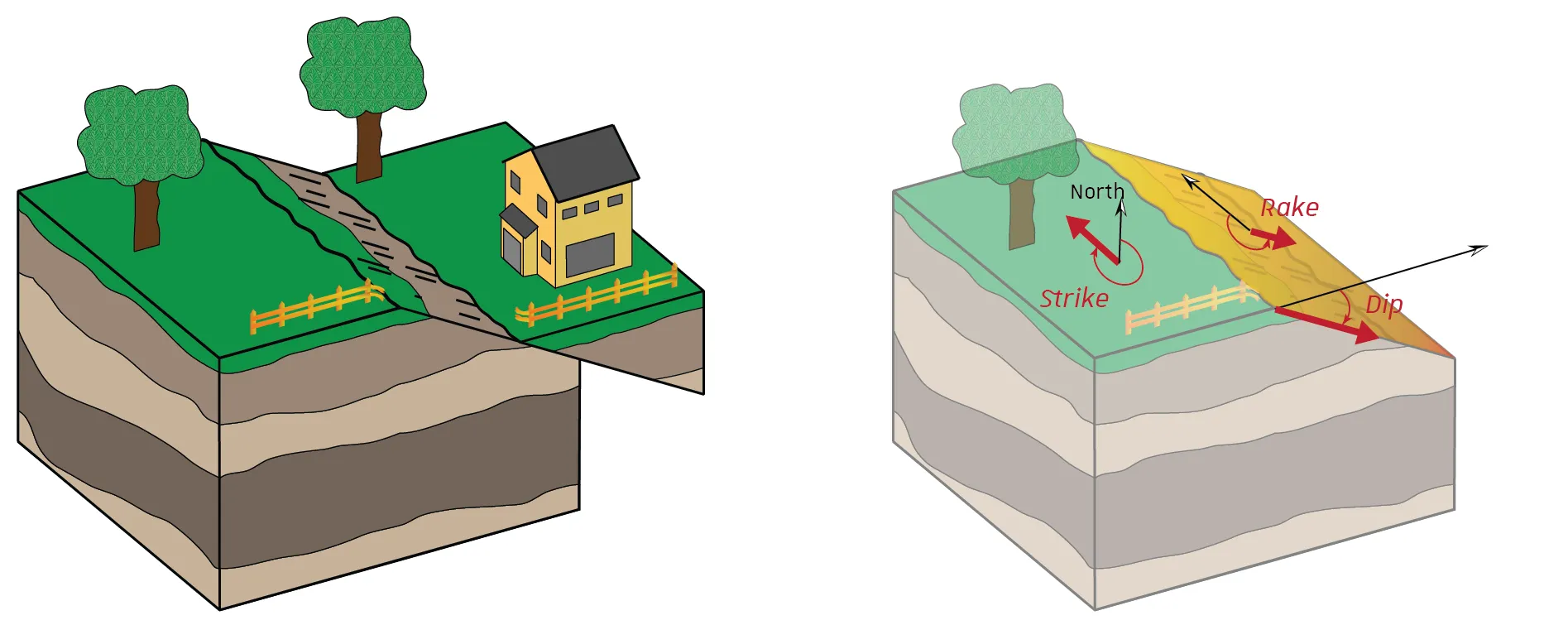
To describe a movement on a fault plane, we indicate its strike (angle relative to north), its dip (inclination relative to the horizontal), and its rake (slip angle on the fault plane, relative to the horizontal).
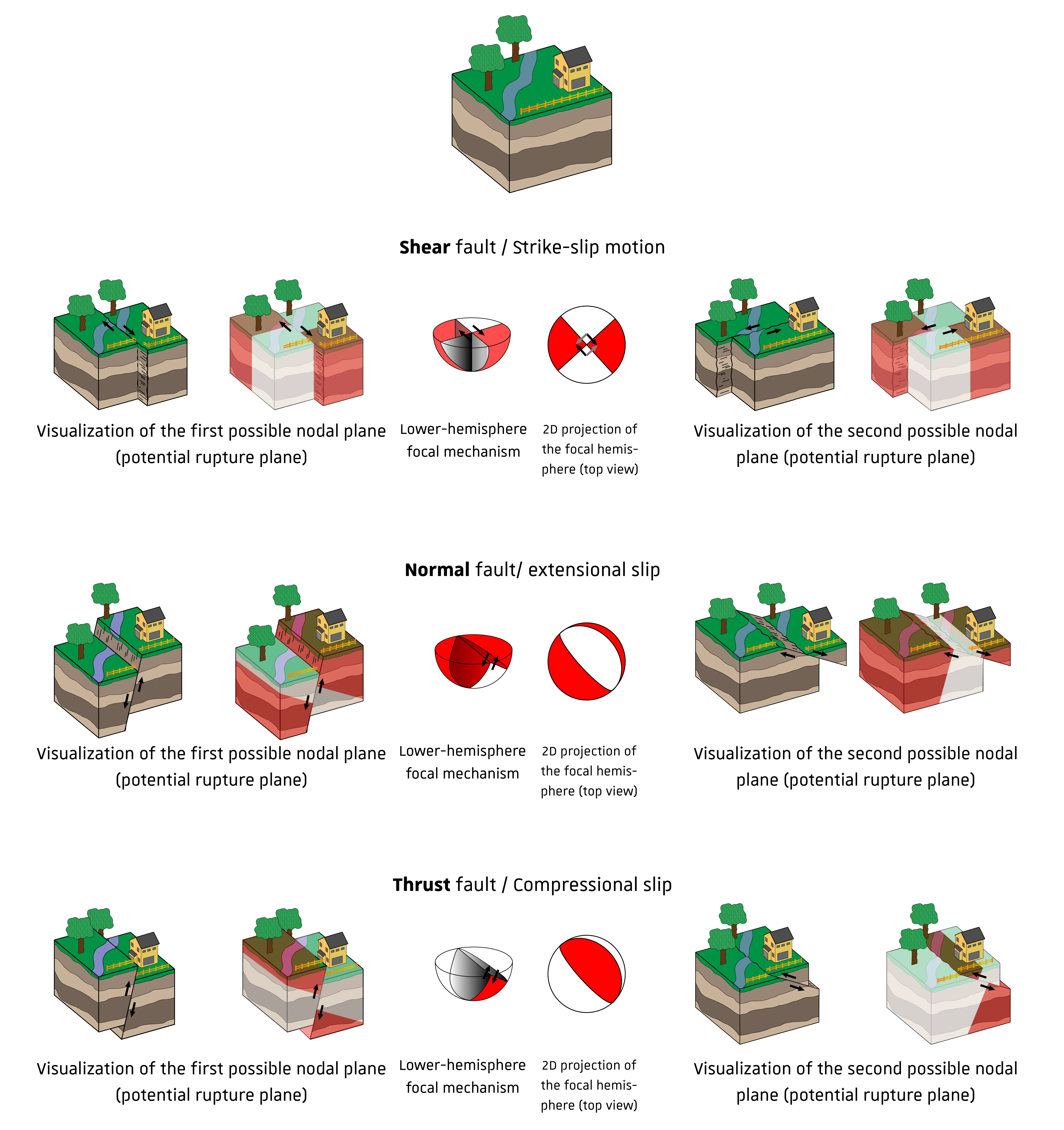
To facilitate the interpretation of these parameters, seismologists use a simplified representation known as a beachball: a projection of the fault orientation and slip direction onto the lower half of a sphere around the earthquake’s hypocenter, with dark sections (in red on the figure below) indicating compression (movement toward that section) and light sections indicating extension (movement away from that section). For an experienced eye, this representation of the focal sphere of an earthquake allows the azimuth, dip, and slip direction of the fault, i.e., the mechanism at the focus of the earthquake, to be quickly visualized.
Without any additional observations (surface fault traces, fault orientation identified by aftershocks, etc.), two different fault planes can explain the recorded data. These are the nodal planes. The example illustrated below shows, for each of the three main types of faults (shear, normal, and thrust), the two possible nodal planes associated with the geometry of the recorded seismic rupture (left and right). In practice, knowledge of the tectonic context of the area under study and surface observations (including satellite imagery) often make it possible to consider one nodal plane as more probable than another (first nodal plane), associating the earthquake with a unique set of Azimuth/Dip/Preferred slip direction parameters.