
Damage to buildings
Classification of damage
Section titled “Classification of damage”Note: the way in which a building deforms under earthquake loading depends on the building type. As a broad categorisation one can group together types of masonry buildings as well as buildings of reinforced concrete.
Classification of damage to masonry buildings
Section titled “Classification of damage to masonry buildings”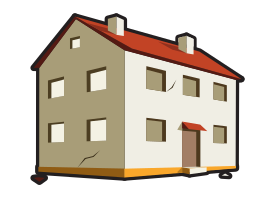
Grade 1: Negligible to slight damage
(no structural damage, slight non-structural damage)
Hair-line cracks in very few walls. Fall of small pieces of plaster only. Fall of loose stones from upper parts of buildings in very few cases.
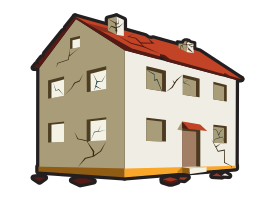
Grade 2: Moderate damage
(slight structural damage, moderate non-structural damage)
Cracks in many walls. Fall of fairly large pieces of plaster. Partial collapse of chimneys.
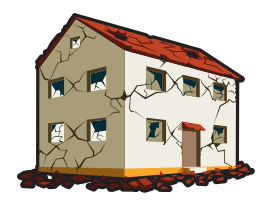
Grade 3: Substantial to heavy damage
(moderate structural damage, heavy non-structural damage)
Large and extensive cracks in most walls. Roof tiles detach. Chimneys fracture at the roof line; failure of individual non-structural elements (partitions, gable walls).
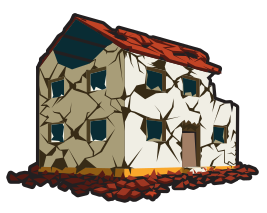
Grade 4: Very heavy damage
(heavy structural damage, very heavy non-structural damage)
Serious failure of walls; partial structural failure of roofs and floors.
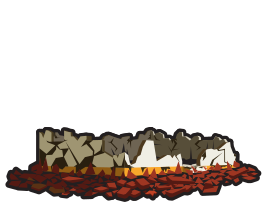
Grade 5: Destruction
(very heavy structural damage)
Total or near total collapse.
Images: modified from © Instituto Geográfico Nacional
Classification of damage to buildings of reinforced concrete
Section titled “Classification of damage to buildings of reinforced concrete”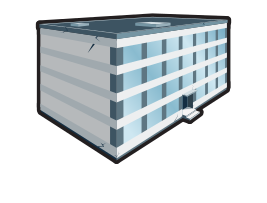
Grade 1: Negligible to slight damage
(no structural damage, slight non-structural damage)
Fine cracks in plaster over frame members or in walls at the base. Fine cracks in partitions and infills.
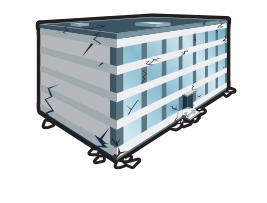
Grade 2: Moderate damage
(slight structural damage, moderate non-structural damage)
Cracks in columns and beams of frames and in structural walls. Cracks in partition and infill walls; fall of brittle cladding and plaster. Falling mortar from the joints of wall panels.
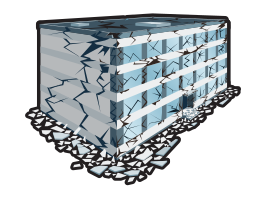
Grade 3: Substantial to heavy damage
(moderate structural damage, heavy non-structural damage)
Cracks in columns and beam column joints of frames at the base and at joints of coupled walls. Spalling of conrete cover, buckling of reinforced rods. Large cracks in partition and infill walls, failure of individual infill panels.
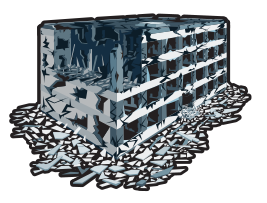
Grade 4: Very heavy damage
(heavy structural damage, very heavy non-structural damage)
Large cracks in structural elements with compression failure of concrete and fracture of rebars; bond failure of beam reinforced bars; tilting of columns. Collapse of a few columns or of a single upper floor.
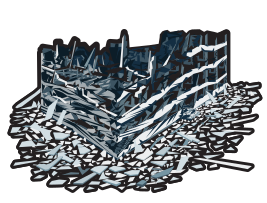
Grade 5: Destruction
(very heavy structural damage)
Collapse of ground floor or parts (e. g. wings) of buildings.
Images: modified from © Instituto Geográfico Nacional
Reference
Section titled “Reference”Grüntal, G. (Ed.) (1998). European Macroseismic Scale 1998 (EMS-98), (Cahiers du Centre Européen de Géodynamique et de Séismologie ; 15), Luxembourg : Centre Européen de Géodynamique et de Séismologie, 99 p. doi:10.2312/EMS-98.full.en